Guide · updated August 2026
Odoo MCP servers, compared honestly.
MCP gave every AI client one way to reach Odoo, and the field responded: a native server from Odoo, strong open-source gateways, paid installed modules, platforms. Connectivity is solved. What separates the options now is execution assurance: what happens when the AI writes, and what you can prove afterwards. Here is how to choose, criteria first.
Written by nanti.ai. We build one of the entries below (available now, marked as such), so read us knowing that. Every other project is treated generously, volatile facts are dated, and corrections are welcome at hello@nanti.ai.
How to evaluate
Judge them on execution, not connection.
Every server on this page can connect an AI to Odoo; that part is the protocol’s gift. These ten questions are where the answers diverge, and they only start to matter the day the AI writes to the database your business runs on.
- 01
Read-back verification
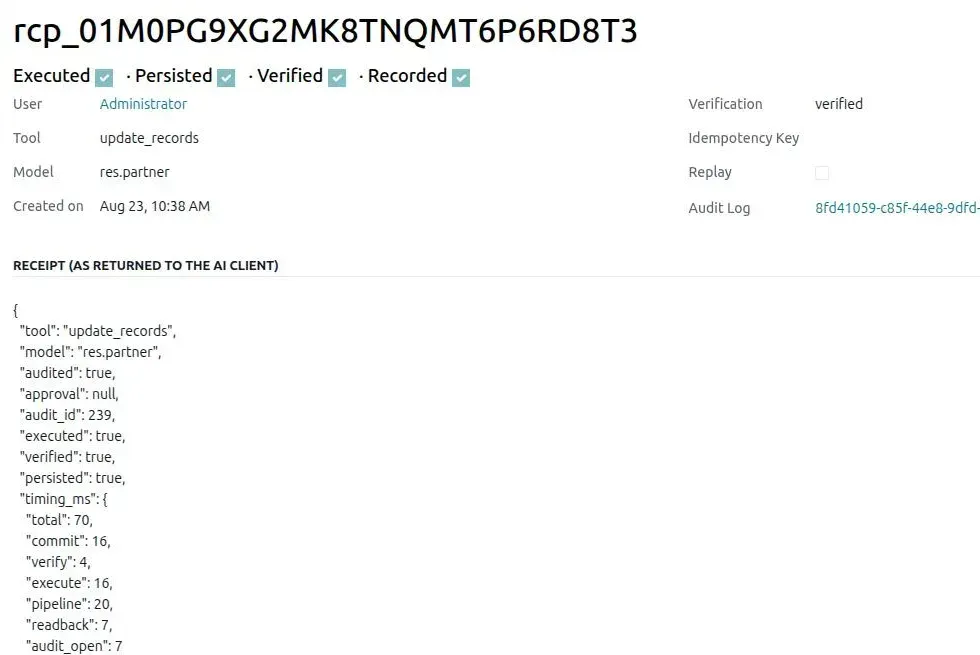
After a write, is the record read back from the database and compared against the intent, or is a success response simply trusted? A write that is reported is not a write that is proven.
- 02
Idempotency keys
If a request times out and the client retries, does the write execute once or twice? Retry safety has to be designed in; it never happens by accident.
- 03
Atomic batches
When the AI writes ten lines and the seventh fails, are the first six rolled back? Half-applied batches are the hardest failures to notice and to clean up.
- 04
Approval workflows
Can destructive actions require a human approval before execution, ideally a different person, with the approval bound to the exact staged change?
- 05
Before-and-after audit
Does the audit keep the values, not just the event? “Something wrote to this record at 14:03” is a log line; “30 days became 45 days” is evidence.
- 06
Audit alerting
Does the log notify a person over email, webhook, or an Odoo activity when something worth attention happens, or does it wait to be opened?
- 07
Role-scoped tool bundles
Can you control which tools even exist per role? A delete tool the salesperson’s AI cannot see is a delete that cannot happen.
- 08
Semantics and disambiguation
When two employees are named John, does the server refuse with candidates, or does the model guess? Deterministic refusal beats a confident coin flip.
- 09
Messaging, governed
If the AI can send a message at all (Discuss, chatter, WhatsApp), who reads the exact words before they leave, and where is the log of every send? Most servers stop at records; messages reach people.
- 10
Per-user identity
Does each person connect as themselves, or does everyone share one key? A shared key means one blast radius and an audit that cannot say who.
- 11
Hosting fit
Odoo Online cannot install custom server modules, so it needs Odoo’s native MCP server or an external gateway. Self-hosted and Odoo.sh can run installed servers.
The landscape
The field, as of August 2026.
Six kinds of answer, each right for someone. Facts below were checked against the live repositories, the Odoo Apps Store, and release coverage in August 2026; they will age, so treat the dates as part of the data.
- Built into Odoo
Odoo’s native MCP server
- Shipped with Odoo 19.4 (July 2026), the rolling release that runs on Odoo Online: one native /mcp endpoint and a scoped MCP key, no gateway to install
- Works with MCP clients such as Claude, ChatGPT, and Cursor
- Calls run under the key’s scope and Odoo’s own access rights; approvals, read-back verification, and before-and-after audit are not part of the published feature set as of August 2026
A good fit whenYou are on Odoo Online. Start here: it is the path Odoo maintains, and no third-party server can be installed there anyway.
- Open source · gateway
erpipe-org/mcp-odoo
- MIT-licensed external gateway, about 390 GitHub stars as of August 2026; 41 tools, multi-instance, runs against Odoo 16+ with your existing credentials
- Writes are gated: a preview, validate, execute sequence with confirmation tokens, an optional write audit log, and an optional confirmation form before execution
- Idempotency keys and automatic batch rollback are not part of the design as of August 2026; a hosted option exists from the same author
A good fit whenA technical team that wants free, gated writes today and is comfortable running a gateway.
- Open source · gateway
ivnvxd/mcp-server-odoo
- MPL-licensed external gateway, about 370 GitHub stars as of August 2026, with a free companion Odoo module for access control
- Solid reading and writing: search, CRUD, server-side aggregation, and invoking public Odoo methods, with per-model permissions configured in Odoo
- Approvals, read-back verification, and before-and-after audit are not part of the published feature set as of August 2026
A good fit whenA clean, popular way to get reading and basic writing working, with permissions managed where your admin already works.
- Paid · installed module
Odoo Apps Store MCP modules
- One-time-purchase modules from established vendors, MuK and Emipro among them, installed inside your own Odoo so every call runs as the key’s owner under Odoo’s record rules
- MuK’s server, for example, ships scoped read-only and read-write keys, a request audit log (30-day default retention), and per-key rate limits as of August 2026
- Request-level audit rather than before-and-after snapshots; approval workflows and verification are not the focus of this generation
A good fit whenSelf-hosted or Odoo.sh teams that want an installed, supported server with a vendor behind it.
- Platform
Automation platforms
- Composio, Zapier MCP, and similar platforms expose Odoo among hundreds of apps through hosted MCP endpoints
- Quick to try and useful for cross-app automations; the Odoo toolsets are generic and shallow compared to dedicated servers, and billing is platform-based
- Governance is the platform’s generic layer, not Odoo-specific, as of August 2026
A good fit whenCross-app automations where Odoo is one stop in a bigger flow, more than deep Odoo work.
- Available now
Execution Layer for Odoo
- Our own entry, held to the harshest reading: version 1.1, available now at USD 499 one-time per Odoo major, everything included, sold direct from nanti.ai and on the Odoo Apps Store, with the Context Layer for Odoo as its one optional add-on. On security we have deliberately not commissioned a third-party penetration test, and we will not claim one. What we point to instead is meant to tell you more than an annual report: the enterprise modules are source-available for you to read, the threat model is published with a test case for every attack path, and the adversarial failure suite that gates our releases ships with the product so you run it on your own staging
- It meets every criterion on this page in one module: per-user OAuth identity, fail-closed writes, read-back verification, idempotency (retry safety), atomic batches, payload-bound approvals, the immutable before-and-after audit with alerting, role bundles, and disambiguation, with nothing held back for a higher tier
- An installed MCP server for self-hosted Odoo 19 and Odoo.sh, Community and Enterprise, endpoints vendor-namespaced under /nanti/ so it coexists with other MCP modules; installs read-only and already recording, with writes off until an administrator allows them
- New in version 1.1, governed messaging: as of September 2026 it is the only Odoo MCP server we know of that can send messages at all (Discuss, record chatter, and WhatsApp through Odoo’s own integration), and every send is previewed word-for-word, gated per user, rate-limited, and logged with the human control it passed. Corrections welcome at hello@nanti.ai
A good fit whenThis criteria list is why it exists: as of September 2026 we have not found another server that covers all of it, and that gap is what it closes.
Spotted something out of date or unfair? Write to hello@nanti.ai and we correct it. A comparison is only useful while it is true.
Plain answers
Asked, answered.
Which Odoo MCP server is best?
It depends on your situation, and anyone who answers without asking is selling something. On Odoo Online, Odoo’s own native MCP server (Odoo 19.4) is the natural start, and the only installable path is Odoo’s. For personal and developer use, the free community gateways are excellent engineering. For business use, judge candidates on the execution criteria: verification by database read-back, idempotency on retries, atomic batches, approval workflows, a before-and-after audit, and alerting. Our own Execution Layer for Odoo is built against exactly those criteria and is available now: one module at USD 499 one-time, everything included, direct from nanti.ai or on the Odoo Apps Store.
What is an MCP server for Odoo?
MCP, the Model Context Protocol, is the open standard that connects AI clients such as Claude, ChatGPT, and Cursor to business systems. An MCP server for Odoo exposes your Odoo as a set of tools those clients can call, so a person can ask questions and act on records in natural language: find the customer, draft the quote, check the stock. The server decides everything else that matters: whose identity the AI acts under, what it may touch, and what evidence remains afterwards.
Do I need one if I am on Odoo Online?
You cannot install third-party server modules on Odoo Online, so the choice is made for you: Odoo’s native MCP server, shipped with Odoo 19.4 in July 2026, with a scoped MCP key. External gateways can also reach a hosted database over its API. For installed alternatives you would need self-hosted Odoo or Odoo.sh.
Are the free community MCP servers safe for business use?
They are good software, and for read-mostly and developer use they are an excellent choice. The honest caution is about writes: as of August 2026, verification by read-back, idempotency keys, and atomic batch rollback are not part of the field’s published feature sets, and approval flows vary from none to a token-gated preview and execute sequence. If an AI will write to the ERP your business runs on, test on a staging copy, start with a read-only key, and check each criterion on this page against the server you pick. We work the write question through in detail at can AI write to Odoo safely (nanti.ai/can-ai-write-to-odoo-safely), and what an audit trail has to do to be evidence at whether Odoo’s native AI has an audit trail (nanti.ai/odoo-ai-audit-trail).
Can I connect Claude or ChatGPT to Odoo today?
Yes. Every route is covered in our step-by-step guides: connect Claude to Odoo (nanti.ai/connect-claude-to-odoo) and connect ChatGPT to Odoo (nanti.ai/connect-chatgpt-to-odoo), including the Odoo Online path, the self-hosted paths, and what to check before business use.
The enterprise bar
Connection is solved. Proof is next.
The criteria on this page are the bar we built the Execution Layer for Odoo against: the enterprise MCP server where every AI action is verified, governed, and audited. It is available now on Odoo 19: one module, one one-time price, everything included. On why connection is only the easy half, there is a founder note: connecting Odoo to AI is the easy half.
Evaluating an AI tool that writes to your Odoo?
Name it. We read its public docs and your description and tell you, in writing within five working days, whether it checks the proposal before it writes, logs the result, or re-reads the committed row after. Sourced line by line, using the same pre-registered method as our public write-verification census. Free, no pitch, and we tell you the truth even if the tool is not ours.
Get the Write-CheckOur own write-verification, the Execution Layer for Odoo, is available now. The verdict stays honest either way.
Not ready to talk? Follow what we ship.
An email when something real ships. No newsletters, no spam.
Living this problem every day and want to shape what comes next? We work closely with a small number of Odoo teams on the Execution Layer for Odoo, the ones who cannot fully trust what their AI writes to production today. Tell us about your Odoo setup.