Odoo 19 · the write path
Can AI write to Odoo safely?
Short answer: yes, but safety lives in the layer between the AI and the database, not in the model and not in the connection. Reading is the easy, low-risk half. The moment an agent can write, an ordinary connection will happily report success the record never received, and leave half of a multi-step change behind when one step is refused. Here is why, and the four things a write has to do to be safe.
Written by nanti.ai. Odoo quotes are verbatim from Odoo’s documentation; the rest are findings we read in the Odoo 19 Enterprise source. We build the Execution Layer for Odoo, which exists to make the write path safe, so read us knowing that. Corrections welcome at hello@nanti.ai.
The failure you don’t see
The AI says done. The database disagrees.
This looks like a clean success, and the agent believes it. But we read the Odoo 19 source: when a server action returns nothing, Odoo composes a success sentence from what the action intended and hands that to the model. So a lock date, a business rule, or a permission can quietly stop the write, and the agent still reports that it worked.
Move Cafe Mujica to 45-day payment terms.
odoo.write res.partner success Done. Cafe Mujica is now on 45-day payment terms.
Illustrative session · sample data
Cafe Mujica is still on 30-day terms. A lock date rejected the write, the action returned nothing, and a success sentence was composed from the intent. The record never changed, and nobody was told.
The record is re-read from the database after commit and compared to the intent. Because the terms did not change, the action is reported as failed, with the reason, not dressed up as success.
The other failure
A denied step can still leave changes behind.
The silent success is one half. The other is the half-applied write. Odoo’s own documentation is clear that enforcement is the tool author’s job, and we found in the source that the AI module does not roll a failed sequence back for you.
There is no savepoint in the AI module’s tool execution. If step three of a five-step action is denied, steps one and two remain written. You are left with a change that is neither done nor undone, and no signal that it happened.
A permission error is caught, converted to text, and returned to the model as a tool result. A denial arrives as advice the model may try to route around, rather than a wall it hits. Enforcement that a prompt cannot skip has to live on the server side of the write.
A server action “does not enforce business rules, modify records directly, or guarantee the correctness of the operation. Its role is limited to decision-making.” The tools that write “must enforce business rules explicitly in Python code.”
Odoo documentationThe answer
Four things a write has to do.
None of these can be prompted into a model, and none of them come free with a connection. They are properties of the layer that stands between the AI and the database. This is the standard the Execution Layer for Odoo is built to, stated as a bar you can hold anything to.
- 01
Run the write in a transaction that rolls back whole
A five-step change either lands completely or not at all. If step three is refused, steps one and two do not stay behind. Half-applied writes are the failures nobody notices until the numbers stop reconciling.
- 02
Read the record back before calling it done
After commit, the record is re-read from the database on an independent connection and compared field by field against what the caller intended. Success is a fact the database confirms, not a sentence composed from what the action meant to do.
- 03
Enforce the rules where a prompt cannot reach
Permissions, approvals, and your business rules are checked on the server side of the write, before it runs. A denial is a wall, not a tool result the model can read and try to route around.
- 04
Keep the refusal, even when the action rolls back
A denial is committed on its own transaction, so the record that the AI tried and was stopped survives the rollback of the thing it tried. What was refused is as much a part of the trail as what went through.
So, safely?
Yes, when the layer does the work.
AI writing to Odoo is safe when a write is atomic, read back from the database, enforced server-side, and recorded before and after. It is not safe when an AI client calls the API and trusts the reply. That is the whole difference, and it is a design choice, not a setting.
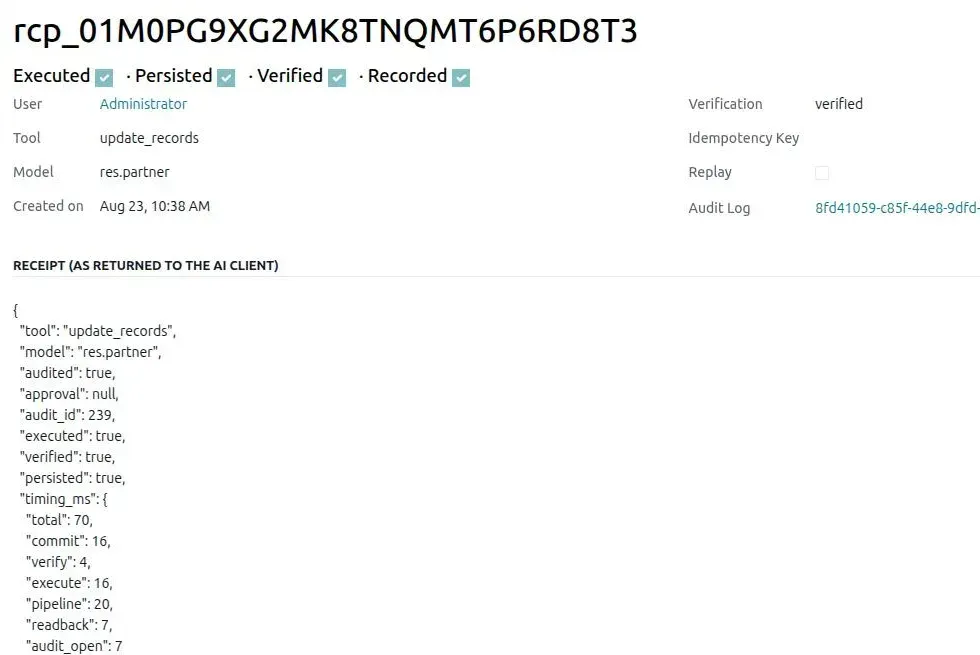
The Execution Layer for Odoo does exactly this: every AI write runs in an atomic transaction, is read back from the database after commit, verified against the declared intent, and recorded as an Action Receipt with the values on both sides. It is available now on Odoo 19 Community and Enterprise, with the enterprise modules source-available so you can read precisely how it behaves rather than take our word for it, and the failure suite ships with the product so you can prove it on your own staging.
Plain answers
Asked, answered.
Can AI write to Odoo safely?
Yes, but safety is a property of the layer between the AI and the database, not of the model or the connection. First, be fair: Odoo 19 ships a real, capable AI agent, and for reading and drafting it is well fenced. Writing safely means four things: run each write in a transaction that rolls back as a whole, read the record back from the database after commit and compare it to what was intended, enforce permissions and business rules on the server side before the write runs, and keep the record of a refusal even when the action it refused rolls back. An AI client that simply calls Odoo’s API and trusts the reply does none of these on its own.
Why does my AI say it updated Odoo when the record did not change?
Because success was reported from intent, not from a database read. We read the Odoo 19 Enterprise source: when a server action returns nothing, Odoo composes a success sentence from what the action intended and hands that to the model. So if a business rule, a lock date, or a permission quietly stopped the write, the agent can still be told it worked, and it will tell you the same. The only reliable fix is to re-read the record from the database after the write and compare it to what was asked for, before anyone calls it done.
If Odoo denies one step of a multi-step change, do the earlier steps get undone?
Not by default. We found in the Odoo 19 source that there is no savepoint in the AI module’s tool execution, so if step three of a five-step action is denied, steps one and two remain written. And a permission error is caught, converted to text, and returned to the model as a tool result, so a denial arrives as advice the model may route around rather than a hard stop. Clean rollback and server-side enforcement are structural properties you have to add; they are not free in the connection.
Isn’t this solved by giving the AI a read-only or limited Odoo user?
A scoped user is a good and necessary control, and you should use one. It limits what the AI may touch. It does not make a write verifiable, roll back a half-applied batch, confirm success by re-reading the database, or keep a tamper-evident before-and-after record. Scope answers "what is it allowed to touch". Safe writing also has to answer "did it actually do what it claimed, and can you prove it afterward".
What does nanti.ai do about this?
The Execution Layer for Odoo is built exactly for the write path: any MCP client connects, and every write runs in an atomic transaction, is read back from the database after commit, verified against the declared intent, and recorded with before-and-after evidence as an Action Receipt. Approvals, preconditions, and per-user identity are enforced server-side, not by prompts. It is available now on Odoo 19 Community and Enterprise, with the enterprise modules source-available so you can read exactly how it behaves. See the Execution Layer for Odoo (nanti.ai/execution-layer). For reading, it is worth understanding why an AI can get your Odoo numbers wrong even when it never writes: why your AI gets Odoo revenue wrong (nanti.ai/why-ai-gets-odoo-revenue-wrong).
The write path
Make the write provable.
Connection is the easy half. The Execution Layer for Odoo is the layer that makes the hard half safe: every AI write verified against the database and recorded before and after. See also how to verify what an AI agent actually wrote, does Odoo’s native AI have an audit trail, which Odoo AI tools actually verify what they wrote, and Odoo MCP servers, compared.
Evaluating an AI tool that writes to your Odoo?
Name it. We read its public docs and your description and tell you, in writing within five working days, whether it checks the proposal before it writes, logs the result, or re-reads the committed row after. Sourced line by line, using the same pre-registered method as our public write-verification census. Free, no pitch, and we tell you the truth even if the tool is not ours.
Get the Write-CheckOur own write-verification, the Execution Layer for Odoo, is available now. The verdict stays honest either way.
Not ready to talk? Follow what we ship.
An email when something real ships. No newsletters, no spam.
Living this problem every day and want to shape what comes next? We work closely with a small number of Odoo teams on the Execution Layer for Odoo, the ones who cannot let an agent write to production on trust. Tell us about your Odoo setup.