Execution Layer for Odoo
Introduction.
The Execution Layer for Odoo is an enterprise execution control layer between any AI and Odoo 19, available now. Every AI action is validated, executed atomically, read back from the database, verified against the intent, and recorded with before and after evidence. This is what it is, who it is for, and how to get it.
An AI agent can do the wrong thing in Odoo and report success. It writes to the wrong record, or reads a truncated list and answers as if it were complete. Nothing errors, nobody notices, and it surfaces weeks later. Reviewing the AI’s plan beforehand cannot catch it, because the mistake happens during execution.
The Execution Layer for Odoo is the fix. It is an enterprise execution control layer that sits between any AI client and Odoo, and it turns “the AI said it worked” into “here is the proof it worked”. Every action runs through one validated pipeline, is verified against the database, and is recorded as evidence you can read. It is available now: one module, USD 499 one-time, everything included.
A standard MCP moves data. It gives an AI reach into Odoo.The Execution Layer proves. It shows what the AI actually did, and enforces your rules.Not another MCP: an execution layer
The Execution Layer speaks MCP, the open protocol, so any MCP client connects to it: Claude, ChatGPT, Cursor, or your own agent stack. But “speaks MCP” is the floor. A standard MCP answers “can the AI reach Odoo”. The Execution Layer answers “did it do what it claims, was it allowed to, and can you prove it afterwards”.
The five pillars
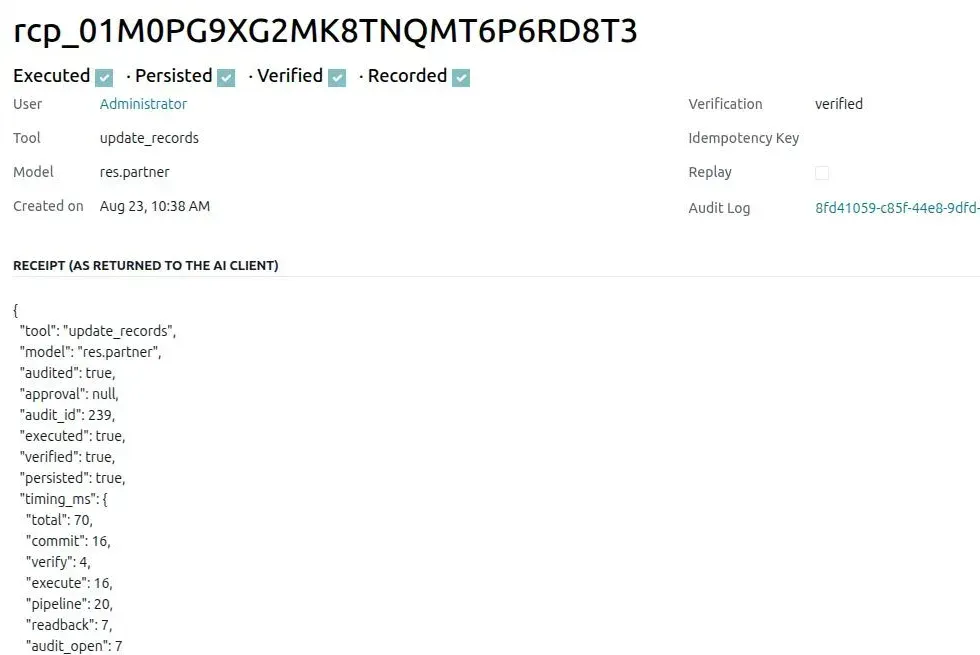
- Verified execution. Every write runs in an atomic transaction, is read back from the database after commit, verified field by field against the declared intent, and returned as an Action Receipt: Executed, Persisted, Verified, Recorded. Idempotency keys make a retry execute once, batches are all-or-nothing, and reads carry an explicit truncation flag.
- Governance. Each user acts under their own Odoo identity over OAuth 2.1. Plain-language role bundles decide which tools even exist per user, and the effective permission only ever narrows. Your business rules become server-side preconditions that no prompt can skip.
- Approvals. Risk-classed actions stop for a human decision, bound to the exact payload; five risk classes ship enabled by default, and the approver can be someone other than the one who asked.
- Evidence. An immutable, hash-chained audit with before and after snapshots, complete per-record history, export trails, and alert rules that notify people over email, a webhook, or an Odoo activity.
- Meaning. A semantic registry per model and field, deterministic refusal of ambiguity (two employees named John produce a structured refusal with the fields to ask for, never a guess), and a built-in client for the Context Layer for Odoo, the one optional add-on.
New in version 1.1: governed messaging. The AI can send Discuss messages, post on record chatter, and send WhatsApp through Odoo’s own integration, with nothing sent until a person confirms or approves the exact words; see messaging, screen by screen.
The fastest way to see all of it is the screen-by-screen walkthrough: real screenshots of every view.
Who it is for
Companies that run self-hosted Odoo 19 or Odoo.sh, Community or Enterprise, and want to let AI act in their ERP without giving up identity, approvals, verification, or the audit trail. The Execution Layer is an installed Odoo module: your records never leave your server, and it never phones home.
Odoo Online
The Execution Layer is not for Odoo Online, which does not allow installing custom server modules. Odoo Online users have Odoo’s own native MCP server. The Execution Layer targets self-hosted Odoo and Odoo.sh only.
Where it stands, and how to get it
Version 1.1, complete and available now. There is no beta and no early access: it shipped when it was whole. It exposes 20 MCP tools, refuses with 42 structured error codes, and is gated on 70+ adversarial failure scenarios that run green on Odoo 19 Community and Enterprise on every release; the suite ships with the product so you can run it on your own staging.
Pricing is one-time: USD 499 per Odoo major, everything included; the one optional add-on, the Context Layer, is the only subscription. To buy, write to hello@nanti.ai or use the Odoo Apps Store: same module, same price. Installation is like any Odoo addon, and it installs read-only: writes stay off until an administrator turns them on.
Wording we hold to
The Execution Layer verifies persistence and permissions, never the AI’s judgment. An authorized but wrong-headed action still executes, and the receipt proves exactly what it did. The rules you write are what stop it. We never claim to make the AI correct.
Its sibling: the Context Layer
The Execution Layer’s sibling is the Context Layer for Odoo, the verified meaning layer, and this product’s one add-on. The two close the loop around every AI action: meaning before the action, proof after it. The Execution Layer works fully without it; where the Context Layer is activated, it supplies what records and fields mean, and the Execution Layer holds every action to it.
For architects and security reviewers, the technical whitepaper covers every mechanism in one document, and Odoo 20 native MCP vs the Execution Layer compares it, use case by use case, with the MCP server built into Odoo 20.
Next: how it works, the one pipeline every tool call runs through.