Context Layer for Odoo
Introduction.
The Context Layer for Odoo (OCL) is the verified meaning layer between any AI and Odoo. A connector moves data; the context layer tells the AI what the data means, which records count, which fields mislead, and whether an action is safe. This is what it is, what it is not, and where early access stands.
AI gets Odoo wrong for one reason that compounds: Odoo’s technical schema does not explain
business meaning. The field names, models, and relations are all there, but nothing in the schema
says that account.move is four different business documents, that amount_total is not a
universal revenue metric, or that a stock quantity means nothing without a warehouse. Hand an AI
the raw schema and it will answer confidently and, often, wrongly.
The Context Layer for Odoo (working label OCL) is the fix. It is a verified meaning layer that sits between any AI and Odoo.
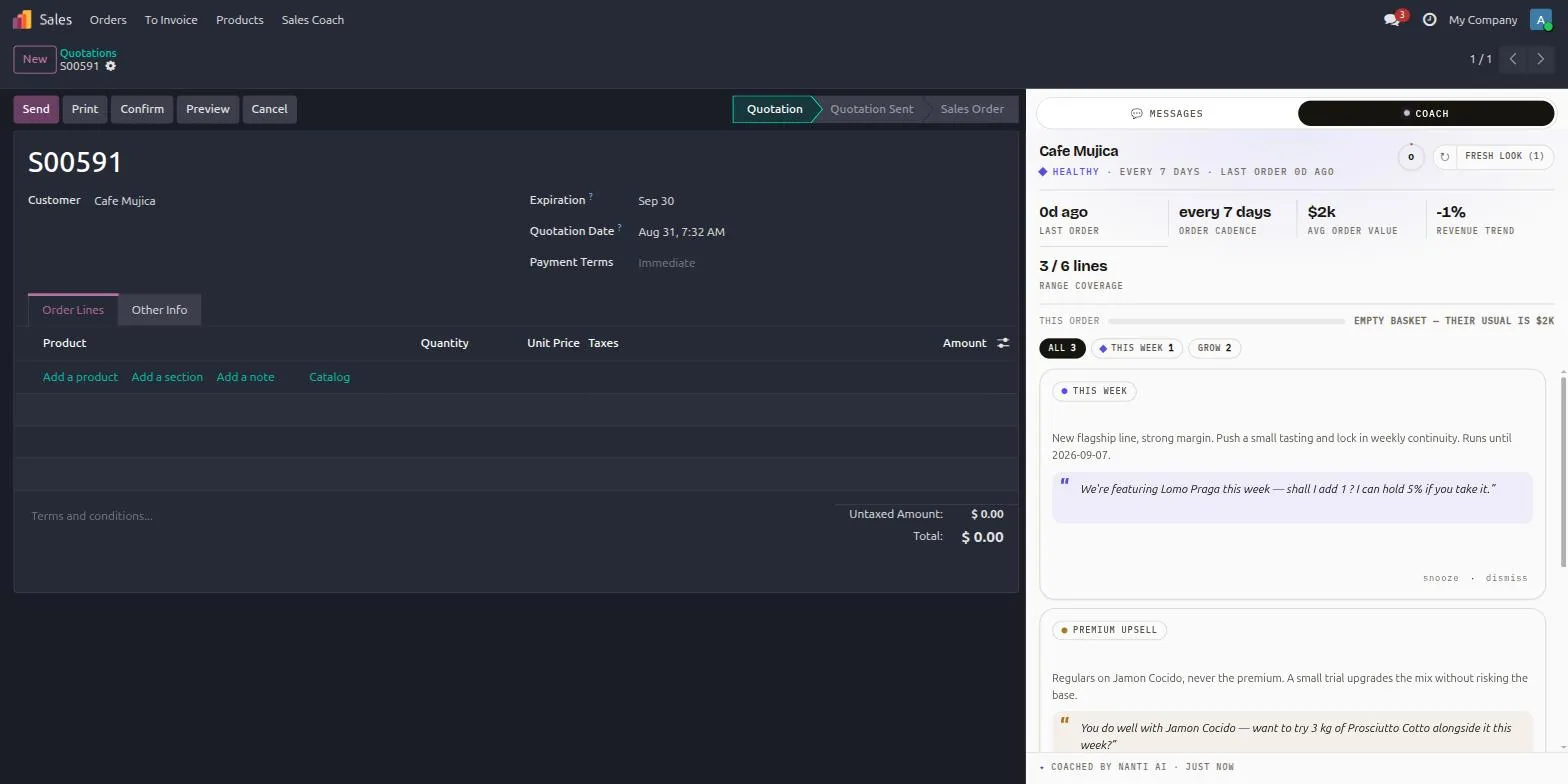
Connector = transport moves data in and out of OdooOCL = meaning says what the data means and which records countAI = reasoning answers or acts, with fewer unsupported assumptionsA question flows through all three:
question -> the connector exposes Odoo -> OCL supplies the smallest verified context for that question -> the AI answers or acts, with fewer unsupported assumptionsWhat OCL tells an AI
- what Odoo records mean;
- which records count;
- which tempting fields or interpretations are wrong;
- which filters and joins matter;
- which company, currency, and security boundaries apply;
- when ambiguity must be clarified;
- when a write is unsafe.
Each of those is a different kind of knowledge, and each fact is proven, not asserted by a language model. See Verification and trust.
What OCL is not
- not a chatbot;
- not another connector;
- not generic RAG over Odoo documentation;
- not a replacement for Odoo permissions;
- not a claim that AI-generated writes are automatically safe;
- not a complete ontology for every Odoo module.
Connector-independent, model-independent
OCL does not move data and does not reason. It supplies meaning to whatever connector moves the data and whatever model does the reasoning. It works alongside your stack, not instead of it.
Where early access stands
This is self-serve developer early access targeting Odoo 19 only (Community and Enterprise), on a v0 format that can still change. A released semantic kernel exists, with executable verification, immutable hash-verified releases, provenance, deterministic retrieval over released content, and risk-preserving context assembly. The consumption surfaces (MCP, REST, Python, TypeScript, and context packs) are implemented.
The open standard is public today at
github.com/Nantiai/ocl-standard (Apache-2.0): clone it
and, in minutes, run the CLI and wire an example MCP server over ten candidate entries. See the
Quickstart. The verified 171-entry runtime is live at
api.context.nanti.ai, self-serve on a free 7-day trial: try one decision with no login at
the demo, then
start a free 7-day trial. The hosted runtime never touches your
Odoo database; your own connector reads the real records under your permissions.
It is honest about its edges: the tenant system is an implemented foundation, not a finished hosted product; the benchmark is designed and running but its independent scoring is not yet published; and “context layer” is a working category label, not a final name. For the current state in detail, see Coverage and release status and Current limitations.
Where to go next
- Quickstart: clone the standard and run it in minutes.
- Use the live runtime: start a free trial and point your AI at the verified 171-entry runtime.
- Why a context layer: the problem, made concrete on
account.move. - Core concepts: the layers, the assembler, and the vocabulary.
- Consuming the layer: the surfaces an AI reads it through.
- The open format: the public spec, schemas, validator, and SDKs.